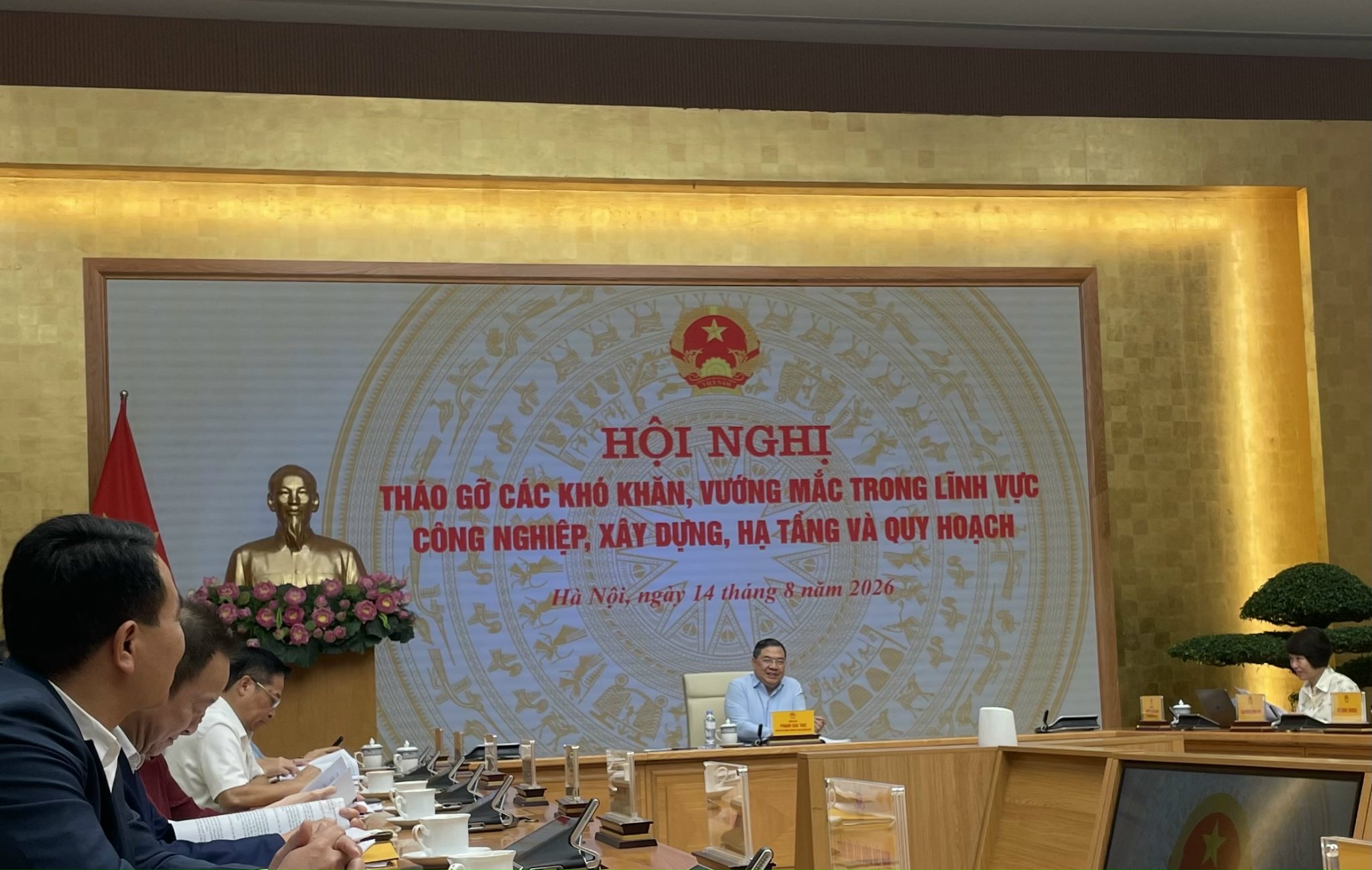



On the morning of August 14, 2026, at the Government headquarters, Mr. Pham Gia Tuc – Politburo Member and Permanent Deputy Prime Minister—chaired a conference to address difficulties and obstacles in the industrial, construction, infrastructure, and planning sectors. This conference was organized to further implement the Prime Minister’s conclusions from the Government Standing Committee’s meeting with the business community on July 18, 2026, themed “Removing bottlenecks, unlocking resources, and boosting growth.”
Attendees included leaders from the Ministries of Finance; Construction; Industry and Trade; Public Security; and Science and Technology; as well as the State Bank of Vietnam and representatives from various associations, major corporations, and enterprises. Ms. Nguyen Thi Duyen, President of the Vietnam Engineering Consultant Association, attended and delivered a speech at the conference.
At the meeting, leaders from the Ministry of Construction and the Ministry of Industry and Trade presented summaries regarding the resolution of proposals submitted by businesses in the industrial, construction, infrastructure, and planning sectors. According to the Ministry of Construction, to resolve difficulties and obstacles—thereby unlocking resources and fostering growth in these sectors—the Ministry has outlined the following key solutions for the upcoming period:
First, focus on researching, formulating, and refining management policies to ensure consistency and uniformity, while streamlining administrative procedures and cutting business conditions to create the most favorable environment for citizens and enterprises; …while simultaneously enhancing training and legal dissemination efforts to ensure that citizens and businesses fully grasp and accurately understand the regulations for proper compliance.
Secondly, focus on the prompt and timely resolution of recommendations and proposals from businesses, particularly those submitted recently by the VCCI and individual enterprises.
Thirdly, regarding new, amended, or supplemented legal documents to be issued in the future, carefully examine transitional provisions to ensure comprehensive coverage and avoid legal gaps, while allowing sufficient time for affected parties to implement the new requirements.
Fourthly, the Ministry of Construction will strengthen coordination and collaboration with associations and businesses in formulating institutions and policies, ensuring a holistic perspective—incorporating the views of state management agencies, the public, and the business community—so that the law effectively translates into practice.
At the conference, VECAS’ President Nguyen Thi Duyen reported that construction consultancy firms still face numerous challenges regarding the local announcement of norms and unit prices for materials. Issues also persist regarding norms, unit prices, and consultancy costs—specifically those related to labor, experts, scientific and technological research and application, and the purchase of licensed software—which remain low relative to business operational needs. The Association agrees with the Ministry of Construction’s proposed solutions and recommends enhanced legal guidance and closer coordination between ministries, sectors, and the Association. Furthermore, while projects may demand rapid execution, reasonable timeframes must be allocated for surveying, design, project management, supervision, and quality control; policies should be established to train and enable domestic consultancy teams to play key roles in major national projects (such as the North-South High-Speed Railway and nuclear power projects…). Regarding the draft Law on Bidding currently under consultation, the Association proposes maintaining the existing provision that does not require contract performance security for construction consultancy services, consistent with the current Law on Bidding and the specific characteristics of this sector.
In his concluding remarks, Permanent Deputy Prime Minister Pham Gia Tuc commended the Ministry of Construction, the Ministry of Industry and Trade, and other ministries and agencies for their proactive and responsible efforts in organizing the conference. He also acknowledged the Vietnam Chamber of Commerce and Industry (VCCI) and business associations for their timely efforts in compiling and conveying the difficulties and obstacles faced by enterprises—particularly in the industrial, construction, infrastructure, and planning sectors—and for proposing solutions to address them.
The Permanent Deputy Prime Minister outlined key tasks to be addressed in the coming period: streamlining administrative procedures; encouraging the business community and associations to uphold the spirit of self-reliance, autonomy, and innovation; proactively enhancing management capabilities, technological standards, product quality, capital efficiency, and competitiveness; and ensuring legal compliance, social responsibility, environmental protection, and the development of a sound business culture.